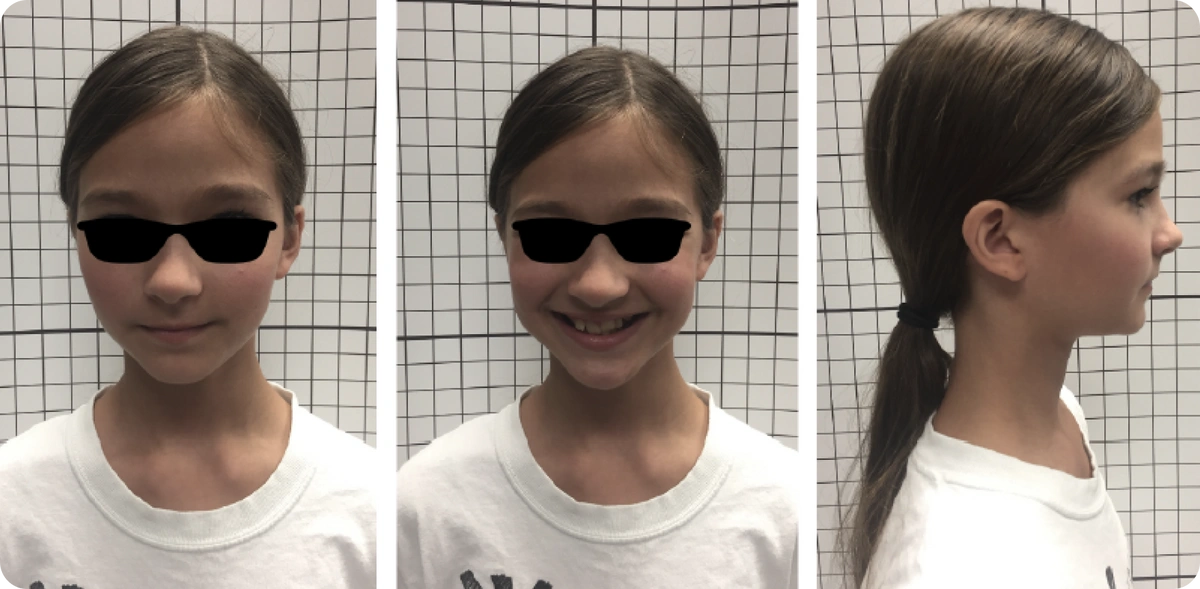
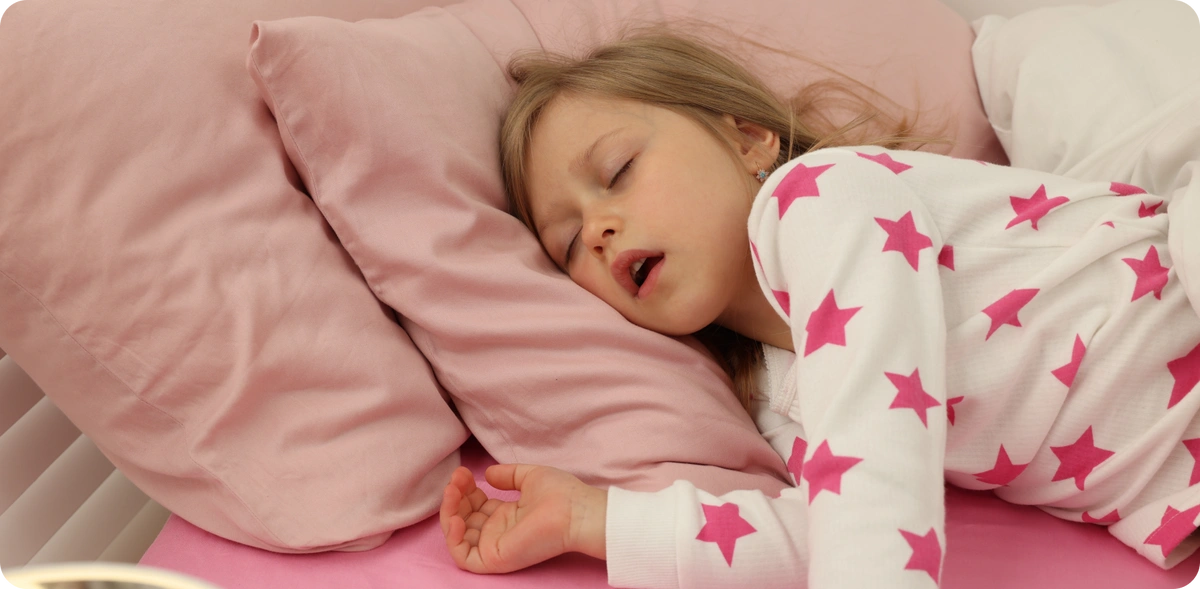
A mouth breathing face takes shape slowly, over years of growth. When a child breathes through their mouth for hours at a time, the tongue drops away from the roof of the mouth and the lips stay apart, and that steady change in posture influences how the jaws and face develop. A mouth breathing face describes a set of facial and dental features sometimes seen in children who regularly breathe through their mouth. It is also called a mouth breather face, adenoid face, adenoid facies, or, in some contexts, long face syndrome.
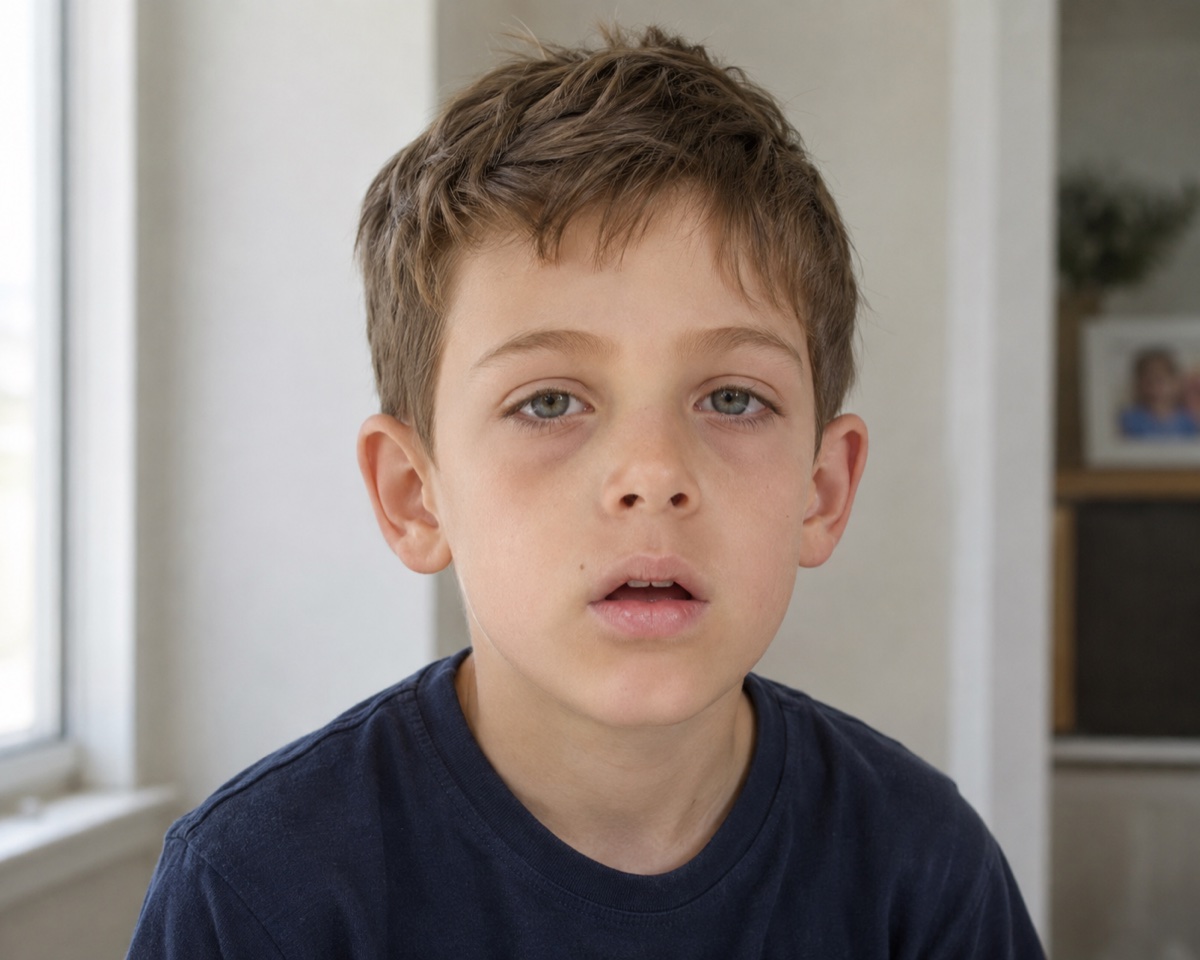
The upper jaw tends to grow narrower without the tongue resting against it, the lower jaw settles into a more downward position, and the middle and lower parts of the face grow longer.
A child's growth also works in their favor here. Because these changes take shape while a child is still growing, they can be guided in a healthier direction. Restoring easy nasal breathing and a proper tongue resting position lets that growth move toward a more balanced pattern, and the earlier it starts, the more of a child's remaining growth there is to work with.
What is a mouth breathing face?
"Mouth breathing face" is an informal description of facial and dental features reported more often in some groups of children with chronic mouth breathing or upper-airway obstruction.
The older term "adenoid facies" came from observations that children with enlarged adenoids sometimes shared features such as lips that remained apart, a narrow upper dental arch, increased lower facial height, and a lower jaw that appeared farther back. "Long face syndrome" is a broader orthodontic term for increased vertical facial growth that often shares the same airway-related origin as mouth breathing.
Studies have found that children who chronically breathe through their mouth, especially when the nose is blocked, are more likely to develop these facial and dental differences.1,3,8
What does a mouth breather face look like in a child?
A child described as having a mouth breathing facial appearance may look longer or narrower through the lower part of the face. The lips may remain separated at rest, and the chin may look recessed because of the position or growth direction of the lower jaw. Inside the mouth, the upper dental arch may appear narrow, the palate may be high, and the teeth may be crowded or show increased overjet.
This can look different from one child to another, and the specific breathing problem behind it shapes how a child's jaw and face develop.7
Dark circles, tired-looking eyes, dry lips, or an open mouth are other signs parents often notice. They can go along with poor sleep, congestion, or resting with the mouth open, and they are worth paying attention to alongside how your child breathes and sleeps.
Noticing some of these signs in your child?
Toothpillow's free virtual assessment gives parents of children ages 3 to 12 a way to have an airway-focused dentist review facial growth, palate shape, teeth, tongue posture, breathing, sleep, and symptoms.
Start the free assessmentHow can mouth breathing influence a child's face?
The everyday things a child does, how they breathe, where their tongue rests, how they chew and swallow, influence how the jaws and face actually grow. This is why two children with similar genes can grow differently, and it is what makes early guidance possible. How a child breathes runs through all of it. When the airway is open and a child breathes through the nose, the tongue rests up against the palate and the lips stay sealed for hours each day, and that resting posture helps guide how the jaws and face grow.
When a child cannot breathe comfortably through the nose, opening the mouth may be an adaptation that allows air to move. The lower jaw may rest lower, the lips may remain apart, and the tongue may sit lower in the mouth rather than maintaining broad contact with the palate. Some children also change their head or neck posture to make breathing feel easier.
The tongue is meant to rest against the roof of the mouth all day, any time a child is not eating or talking, and that steady upward contact helps guide the upper jaw to grow wide and forward. Orthodontic research shows that this kind of light, constant force shapes tooth and arch position more than the brief, stronger pressure of swallowing.10 When a child breathes through the mouth, the tongue drops away from the palate for hours at a time, and the jaw loses that natural guiding force.
What the research shows
Early treatment guides future growth
When a child's airway problem is treated early, the growth that is still ahead of them can shift in a healthier direction. This happens gradually, over the next few years, as the child keeps growing.
What causes a child to breathe through their mouth?
Mouth breathing is usually a sign that something is making it hard for a child to breathe through their nose. Finding out what that something is matters, because the fix for enlarged adenoids is different from the fix for allergies, a narrow jaw, or a habit that sticks around after congestion clears.
Enlarged adenoids or tonsils
Adenoids sit behind the nose, and tonsils sit at the sides of the throat. When either tissue becomes enlarged, airflow can become restricted, especially during sleep. A child may respond by opening the mouth, snoring, moving frequently, extending the neck, or sleeping in unusual positions.
Allergies and chronic nasal congestion
Seasonal or year-round allergies can inflame the nasal lining and make nasal breathing feel difficult. Recurrent colds, chronic rhinitis, swollen turbinates, environmental irritants, and ongoing congestion may produce a similar response. Because these conditions can change from day to day, a child may breathe through the nose during an office visit but open the mouth throughout the night.
Jaw development and limited space for the tongue
The upper jaw forms the floor of the nose and the roof of the mouth, so when it develops narrow, it leaves less room for both the tongue and for air to move through the nose. A lower jaw that sits farther back leaves less room behind the tongue as well. This works as a cycle: underdeveloped jaws make breathing harder, and mouth breathing then shapes how the jaws keep growing.
Sleep-disordered breathing
Some children mouth breathe because airflow becomes more difficult during sleep. Snoring, breathing that stops and restarts, gasping, or frequent arousals can be signs of sleep-disordered breathing or obstructive sleep apnea. The National Heart, Lung, and Blood Institute lists snoring, gasping, and breathing that starts and stops among common sleep apnea symptoms.13
Other signs of mouth breathing to watch for
Some of the most telling signs show up in how a child breathes and sleeps. Watch how your child rests when they are relaxed, how they breathe at night, and how they feel when they wake up. Noticing these patterns at home is exactly the kind of information that helps an airway-focused review make sense of what is going on.
Is a mouth breathing face permanent?
Not necessarily, and that is the encouraging part. While a child is still growing, their face and jaws are still forming, which means there is a real opportunity to guide that growth in a healthier direction.
When the underlying breathing problem is addressed early, a child's later growth can shift toward more balanced development.1,2,3,4
The younger a child is, the more growth they have ahead of them, and the more room there is to guide it in a healthier direction. About 90 percent of a child's facial growth is complete by age 12, which is why Toothpillow works with children ages 3 to 12, while that growth can still be shaped. Starting early gives a child the biggest advantage, and for those past that window, the Toothpillow Teen and Adult program supports breathing and oral posture at older ages.
Can a mouth breathing face be reversed?
Restoring easy nasal breathing, guiding the jaws while a child is still growing, and helping the tongue and lips rest in a healthier position can all move a child's development in a better direction.3,5,6,11,12
As those things improve, parents often see the visible signs ease: a narrow smile widening, lips that can rest closed, and quieter, more settled sleep, all following the child's own growth.
How is mouth breathing in children evaluated?
A good evaluation starts with how a child breathes and sleeps, then looks at how their jaws, palate, teeth, tongue, and lips are developing. It connects what you notice at home, like open-mouth sleep, snoring, restless nights, congestion, or daytime tiredness, with what is happening structurally as the child grows.
This is exactly what an airway-focused dentist is trained to do. They evaluate the whole picture together: how a child breathes, how they sleep, and how their jaws, palate, teeth, tongue, and lips are developing. That complete view is what makes it possible to catch a growth problem early and guide it while there is still time.
How is mouth breathing face treated?
Treatment works best when it targets the underlying cause, which is often underdeveloped jaws and the loss of easy nasal breathing that comes with them. When a child breathes through their mouth, the airway stays dry and irritated, and tissue like the tonsils and adenoids can stay swollen and enlarged.9 Guiding the jaws to develop fully, restoring nasal breathing, and improving tongue posture relieves that, and many children see congestion ease and that tissue calm down as their breathing normalizes.
This is the heart of airway-focused dental care, which treats breathing and facial growth together instead of in separate silos. Guiding jaw growth, widening a narrow palate, and retraining tongue and lip posture can steer a child's development in a healthier direction. Because this care creates the room the teeth and jaws need, it can address crowding and bite problems at their source, rather than only straightening teeth after the fact.
How Toothpillow evaluates mouth breathing and facial growth
Toothpillow offers a free virtual pediatric airway assessment for children ages 3 to 12 in the United States. Parents upload six guided photos of the child's face, bite, upper arch, lower arch, and tongue position, then complete a clinical intake about breathing, sleep, symptoms, and development.
Toothpillow's clinical leadership and a licensed Toothpillow airway dentist in the child's state review facial growth, palate width, dental spacing, jaw position, tongue posture, lip seal, and parent-reported symptoms. The review is designed to help determine whether development appears to be on track, whether the Toothpillow program is the right fit, or whether the child would benefit from starting with in-person care.
For children who are candidates, the Toothpillow program is a 24-month process that may include guided-growth oral appliances, myofunctional exercises, nasal hygiene, app-based photo and video check-ins, ongoing clinical review, and care coordination. The goal is to give families the full growth and breathing picture in one place, along with a clear next step.
Have an airway-focused dentist review the full picture
The free Toothpillow assessment looks at facial growth, palate and dental development, tongue and lip function, breathing, sleep, and the symptoms you see at home. Every child receives a clear recommendation and a next step.
Get your child's free assessmentWhen should a parent have their child evaluated?
Every child benefits from having their airway and facial growth checked while they are young, which is why the American Dental Association and the American Academy of Pediatric Dentistry both recommend screening children for airway and sleep-related breathing problems as part of routine care.14,15 Catching a growth or breathing concern early, before it shapes years of development, is far easier than correcting it later.
Some signs make an assessment especially urgent: frequent mouth breathing, snoring, gasping, breathing pauses, chronic congestion, restless sleep, grinding, waking with a dry mouth, persistent bedwetting, daytime fatigue, difficulty focusing, lips that stay apart, a narrow palate, or developing crowding. When several show up together, that is a strong reason to act, and a child does not even need a full list of symptoms to be worth checking, because an early assessment is about catching what is easy to miss while growth can still be guided.
See how your child is breathing and growing
Toothpillow's free virtual assessment is available to U.S. families with children ages 3 to 12. Upload six guided photos, share what you notice about breathing and sleep, and receive an airway-focused clinical review with recommended next steps.
Start the free pediatric airway assessmentFrequently asked questions about mouth breathing face
Does sleeping with your mouth open change your face?
Occasional open-mouth sleep during a cold will not shape a child's face. But habitual mouth breathing, night after night, changes where the tongue and jaw rest for hours at a time, and over months and years that can influence how the jaw, dental arch, and face grow.
What age does mouth breathing start changing a child's face?
Earlier is better. About 90 percent of a child's facial growth is complete by age 12, so the years before then are when growth can most easily be guided. There is no single birthday when the door closes, but the younger a child is, the more room there is to make a difference, which is why Toothpillow works with children ages 3 to 12.
Can mouth breathing cause a recessed chin?
Yes. Chronic mouth breathing and airway obstruction are linked with a lower jaw that grows in a more downward and backward direction, which can make the chin look recessed. A recessed chin can also run in families, so it is one sign to look at alongside how a child breathes, sleeps, and grows.
Can mouth breathing cause a narrow palate?
Yes. Children who breathe through their mouth often have narrower dental arches and a higher palate. When the tongue drops from the roof of the mouth, the upper jaw loses the steady, gentle contact that guides it to grow wide, so the arch tends to develop narrow and high instead.
Will removing adenoids or tonsils reverse mouth breathing face?
Not on its own. Removing the tissue can open the airway, but it does not retrain a child to breathe through their nose or guide the jaw growth that shapes the face. In many children, restoring nasal breathing and proper tongue posture calms the inflammation that enlarged the tonsils and adenoids in the first place, and guiding growth early is what changes how the face develops.
What type of doctor treats mouth breathing in children?
An airway-focused dentist is trained to look at the underlying cause of mouth breathing, evaluating how a child breathes, rests their tongue, and grows together rather than treating one symptom at a time. Many families see other providers first for related concerns, but those visits often address a single piece and miss the underlying airway and growth pattern. An airway-focused assessment connects those pieces and guides a child's growth while there is still time.
The best time to act is while a child is growing
A mouth breathing face is a signal worth paying attention to. It often points to something making nasal breathing hard, and during childhood, that can shape how the jaws and face grow. Persistent mouth breathing may involve nasal obstruction, sleep-disordered breathing, oral rest posture, jaw development, or several of these working together.
The encouraging part is that a child's growth is not fixed. While they are still developing, addressing the breathing problem and guiding their growth can move things in a healthier direction, and the younger you start, the more room there is to make a difference. This is what airway-focused dentistry does, and it is changing how children with these signs are helped.
If you are noticing these signs in your child, the simplest next step is a look at the whole picture: how they breathe, how they sleep, and how their jaws and teeth are developing. That is exactly what Toothpillow's free assessment is built for.
Find out what your child's face is telling you
Toothpillow's free virtual assessment gives parents of children ages 3 to 12 an airway-focused dentist's review of facial growth, palate and jaw development, tongue and lip posture, breathing, and sleep. Upload six guided photos and get a clear picture and a next step.
Start your child's free assessmentReferences
- Zettergren-Wijk L, Forsberg CM, Linder-Aronson S. Changes in dentofacial morphology after adeno-/tonsillectomy in young children with obstructive sleep apnoea: a 5-year follow-up study. European Journal of Orthodontics. 2006;28(4):319-326. doi:10.1093/ejo/cji119.
- Linder-Aronson S, Woodside DG, Lundström A. Mandibular growth direction following adenoidectomy. American Journal of Orthodontics. 1986;89(4):273-284. doi:10.1016/0002-9416(86)90049-7.
- Becking BE, Verweij JP, Kalf-Scholte SM, et al. Impact of adenotonsillectomy on the dentofacial development of obstructed children: a systematic review and meta-analysis. European Journal of Orthodontics. 2017;39(5):509-518. doi:10.1093/ejo/cjx005.
- Nascimento RR, Masterson D, Mattos CT, Vilella OV. Facial growth direction after surgical intervention to relieve mouth breathing: a systematic review and meta-analysis. Journal of Orofacial Orthopedics. 2018. doi:10.1007/s00056-018-0155-z.
- Markkanen S, Rautiainen M, Niemi P, Helminen M, Peltomäki T. Is securing normal dentofacial development an indication for tonsil surgery in children? A systematic review and meta-analysis. International Journal of Pediatric Otorhinolaryngology. 2020;133:110006. doi:10.1016/j.ijporl.2020.110006.
- Caixeta ACP, Andrade I Jr, Bahia-Junior M, et al. Dental arch dimensional changes after adenotonsillectomy in prepubertal children. American Journal of Orthodontics and Dentofacial Orthopedics. 2014;145(4):461-468. doi:10.1016/j.ajodo.2013.12.018.
- Lekvijittada K, Uengkajornkul P, Changsiripun C. Dental arch dimension and palatal morphology in children and adolescents with mouth breathing: a systematic review and meta-analysis. BMC Oral Health. 2026. doi:10.1186/s12903-026-08349-9.
- Vig KW. Nasal obstruction and facial growth: the strength of evidence for clinical assumptions. American Journal of Orthodontics and Dentofacial Orthopedics. 1998;113(6):603-611. doi:10.1016/S0889-5406(98)70219-7.
- Kukwa W, Guilleminault C, Tomaszewska M, et al. Prevalence of upper respiratory tract infections in habitually snoring and mouth breathing children. International Journal of Pediatric Otorhinolaryngology. 2018;107:37-41. doi:10.1016/j.ijporl.2018.01.022.
- Proffit WR. Equilibrium theory revisited: factors influencing position of the teeth. Angle Orthodontist. 1978;48(3):175-186.
- Nascimento RR, Masterson D, Mattos CT, Vilella OV. Dentoalveolar alterations after interventions to relieve mouth breathing: systematic review and meta-analysis. Journal of Orofacial Orthopedics. 2026;87(2):168-183. doi:10.1007/s00056-024-00568-5.
- Singla A, et al. Impact of adenotonsillectomy or adenoidectomy on dentofacial development of children with obstructed sleep disordered breathing: systematic review. International Journal of Pediatric Otorhinolaryngology. 2026. doi:10.1016/j.ijporl.2026.112923.
- National Heart, Lung, and Blood Institute. Sleep Apnea Symptoms. Updated January 9, 2025.
- American Dental Association. The Role of Dentistry in the Treatment of Sleep Related Breathing Disorders. ADA policy statement; adopted 2017.
- American Academy of Pediatric Dentistry. Policy on Obstructive Sleep Apnea (OSA). The Reference Manual of Pediatric Dentistry. Chicago, Ill.: American Academy of Pediatric Dentistry.