Most parents who look into thumb sucking have already been told it might affect their child's teeth, and have probably tried more than once to get their child to stop. Thumb sucking and pacifier use are normal ways young children soothe themselves, and most children ease out of the habit on their own.
What matters for a child's teeth is whether the habit continues often enough, hard enough, and long enough to change teeth that are still coming in and a jaw that is still developing. This article covers how thumb sucking affects the teeth and bite, why children do it, how it connects to the palate and airway, and what actually helps.

The dental effects of a sucking habit come from steady, repeated pressure over months and years. A thumb or pacifier held in the mouth for hours a day sits where the tongue would normally rest, and that changes the balance of gentle forces that shape a child's bite, the width of their upper jaw, and the shape of their palate.
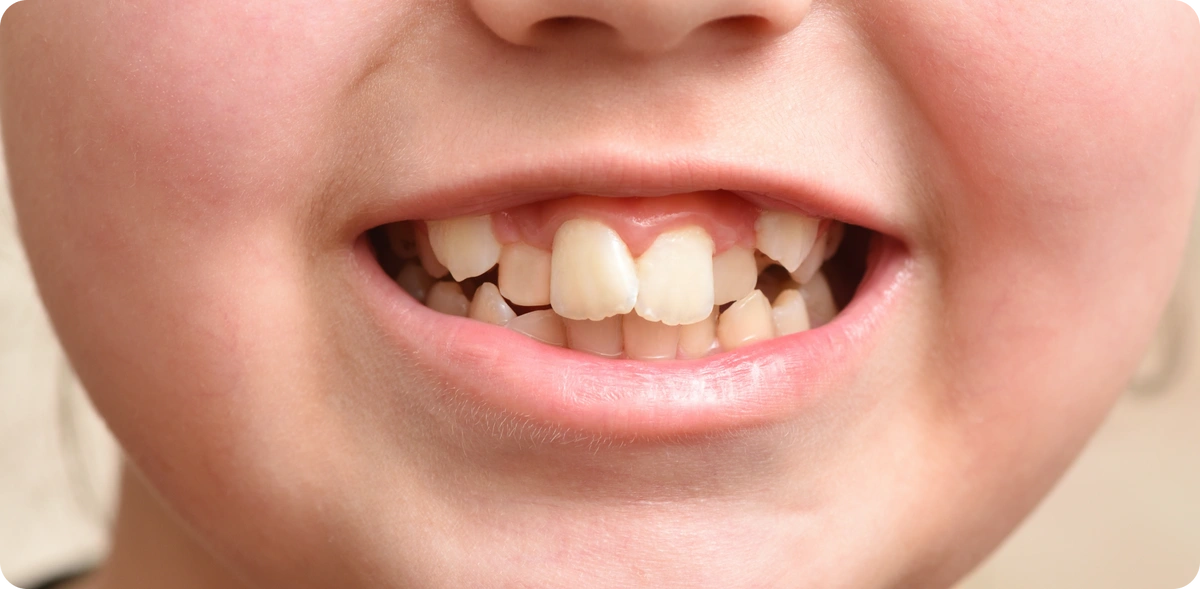
The change most consistently linked to a thumb habit is an open bite, where the top and bottom front teeth do not meet. How much it affects your child comes down mostly to how long the habit lasts, plus how often and how hard they suck.1
Does thumb sucking affect a child's teeth?
Yes, when it goes on long enough. The clearest and best-documented effect is an anterior open bite, where the top and bottom front teeth do not meet even when the back teeth are closed. In a 2026 review that combined 12 studies, children who sucked a thumb or fingers had about five times the odds of an open bite compared with children without the habit, and children who used a pacifier had about seven times the odds.1 These are averages across groups of children, not a prediction for any one child, and a light or short-lived habit is very different from a strong one that continues for years.
How thumb sucking changes the bite: open bite, overjet, and crossbite
A sucking habit acts on a child's front teeth, back teeth, and the shape of their developing upper jaw and palate. Most children develop just one or two of these changes, and which ones depend on where the thumb or pacifier sits and how long the habit goes on.
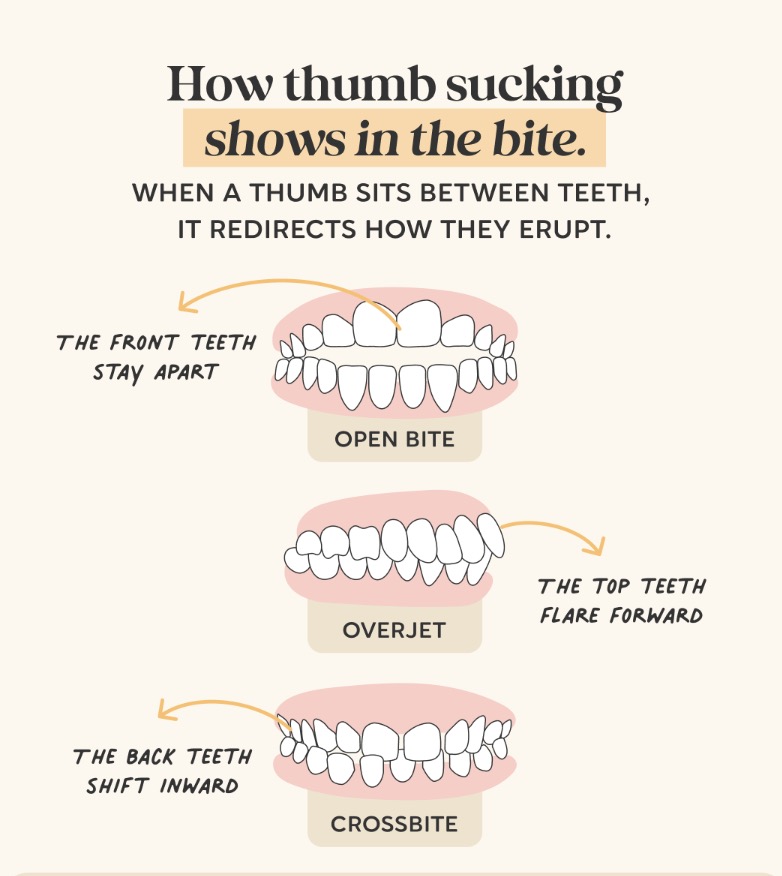
A crossbite is worth calling out, because it behaves differently from an open bite. It is linked more strongly to prolonged pacifier use than to thumb sucking, and a 2024 randomized trial found that non-nutritive sucking lasting a year or longer raised the chance of a crossbite.1,6
Noticing these changes in your child's bite?
Toothpillow's free virtual assessment lets an airway-focused dentist review your child's bite, upper jaw, tongue posture, and how their jaws are developing, for children ages 3 to 12.
Start the free assessmentWhy do children suck their thumb?
Sucking is one of the first things a baby does, and for young children a thumb or pacifier is a way to self-soothe. It calms them, helps them settle, and often helps them fall asleep, which is part of why the habit can be so hard to break.5 Most children let go of it on their own between the ages of two and four.
Sucking, tongue posture, and how a child breathes are closely linked, and children who suck often show other signs like mouth breathing or restless sleep.10 Many airway-focused clinicians see the habit as part of that larger airway picture, and researchers are still working out exactly how the pieces influence one another. What is already clear is that a prolonged habit narrows the palate and lowers the tongue, leaving less room for the airway. Because the habit and a child's breathing are so intertwined, the most useful thing a parent can do is have both looked at together, rather than treat the thumb in isolation.
How long does thumb sucking take to affect a child's teeth?
The risk rises with how long the habit continues, and the strongest evidence points to duration. A study that followed 372 children from infancy found that habits lasting four years or longer produced the greatest changes, including increased overjet, open bite, and a narrower upper jaw, while shorter habits were tied to smaller, less consistent changes.2,13
Daily use, and especially sucking through the night, gives the habit more hours to act, so both how often and how long a child sucks add to the effect.7 Pediatric dentistry guidance notes that the duration of a gentle force matters more than its peak strength, since the tongue, lips, cheeks, and anything held in the mouth act on the teeth for long stretches at a time.4 Pediatric dentistry guidance recommends helping children ease off a sucking habit by around age three to protect the developing bite.3
What the research shows
The bite can improve, but that is not the whole picture
Once the habit stops, many open bites get smaller or close on their own as the front teeth keep coming in, including in children older than four.12 What an improving bite can hide is the development that did not happen while the thumb or pacifier was in the way: the tongue was not resting against the roof of the mouth to guide the upper jaw and palate to grow wide. A child can end up with straighter-looking front teeth and still have a narrower jaw and palate, and less room for their airway. Guiding a child's growth early, while the jaw is still developing, is what gives the airway and the jaw the chance to catch up, not just the teeth.
How thumb sucking affects the jaw, tongue, and airway
The tongue is meant to rest against the roof of the mouth, and that steady upward contact is part of what guides the upper jaw to grow wide.9 A thumb or pacifier held in the mouth takes up the space the tongue would use, holding the front teeth apart, pressing the upper teeth forward, and training the tongue to rest low. Over months and years, that is one reason an open bite, a narrower and higher palate, and a low resting tongue posture so often show up together.1,7,8
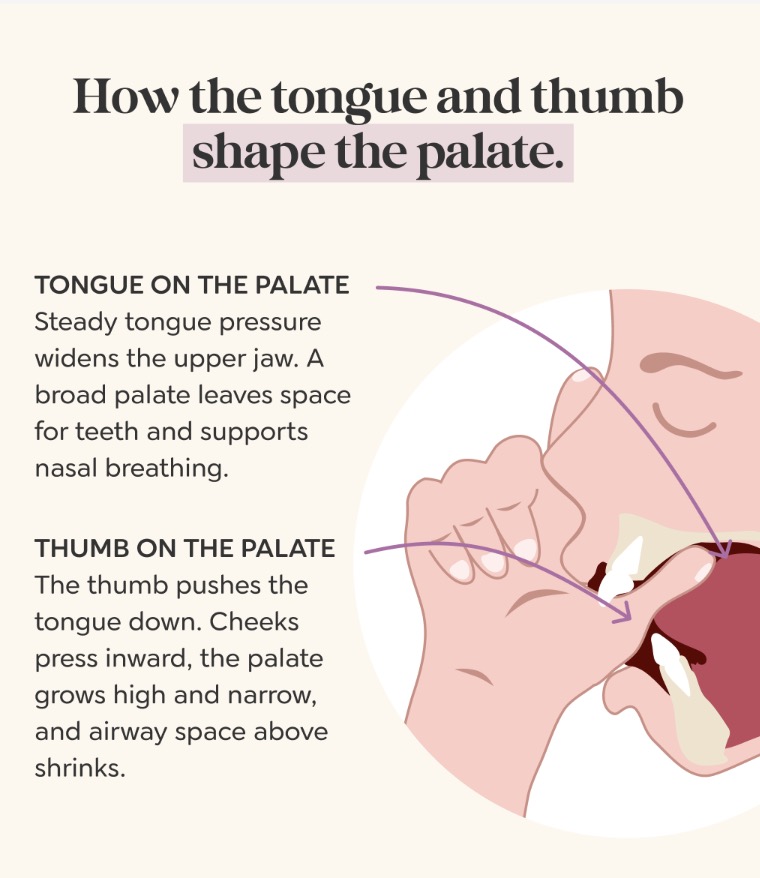
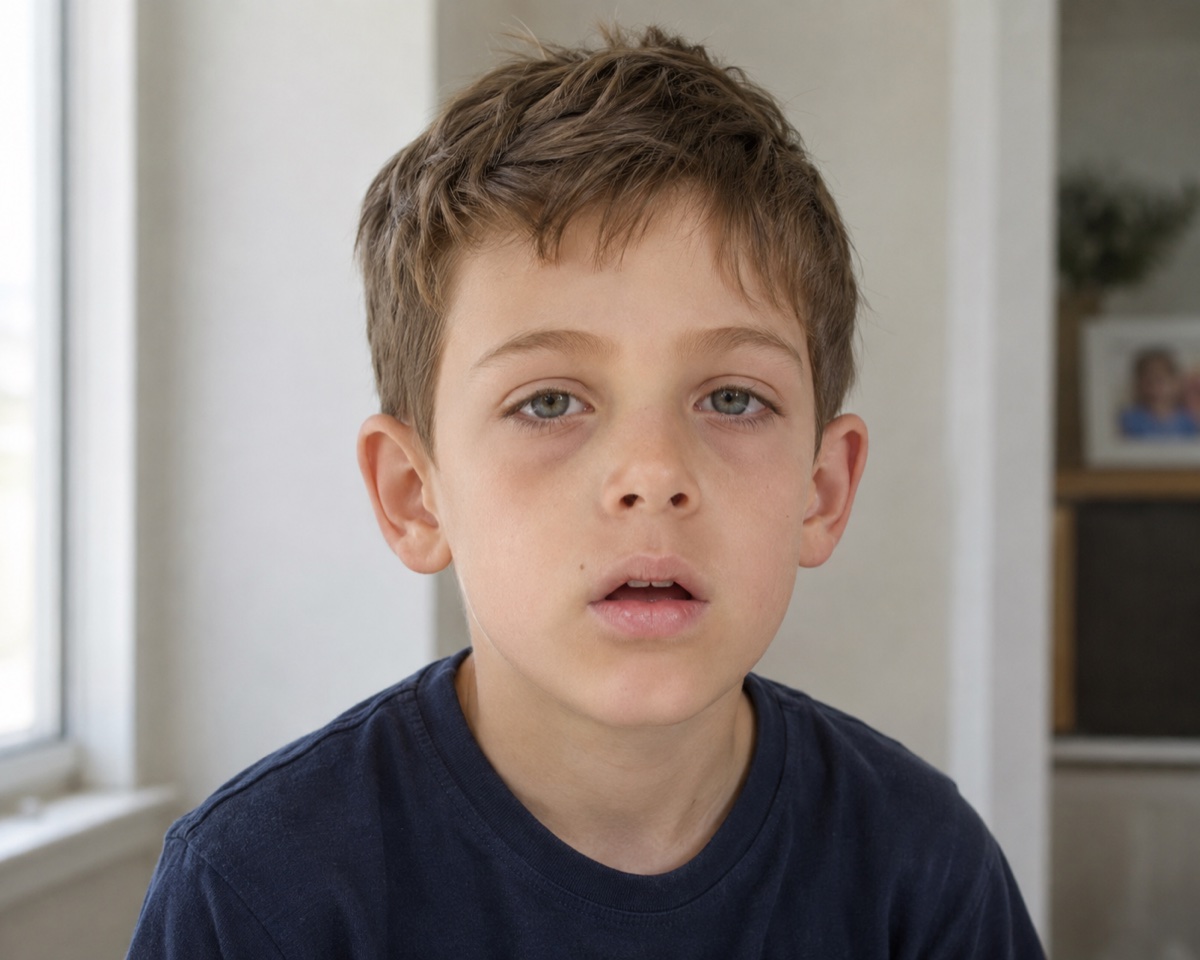
There is an important overlap with breathing here. A habit like thumb sucking or pacifier use keeps the mouth open and reinforces an open-mouth resting posture, and chronic mouth breathing is linked to a longer pattern of facial growth, with the lower jaw rotating down and back rather than forward.16 Oral habits and mouth breathing often appear together with malocclusion in the same children.10 A narrow palate and a low tongue also leave less room for the airway, and children with these features have higher rates of sleep-disordered breathing.11 Thumb sucking has not been shown to directly cause sleep apnea, but by narrowing the palate and lowering the tongue it can be one contributor to the crowded-airway pattern that raises the risk. If your child snores, breathes through their mouth, or sleeps restlessly, it is worth reading our guide to what mouth breathing does to a child's face.
Can thumb sucking cause a lisp or speech problems?
Yes, when it leaves an open bite behind. With the front teeth no longer meeting, a child pushes the tongue forward through the gap to swallow and to make sounds like "s" and "z," and an open bite is closely linked with this kind of forward, low tongue posture, known as a tongue thrust.15 Children with an open bite also have speech-sound problems, such as a frontal lisp, far more often than children whose teeth meet normally.14 Closing the bite and retraining the tongue is what addresses it at its source, rather than speech practice alone.
How Toothpillow looks at thumb sucking and a child's bite
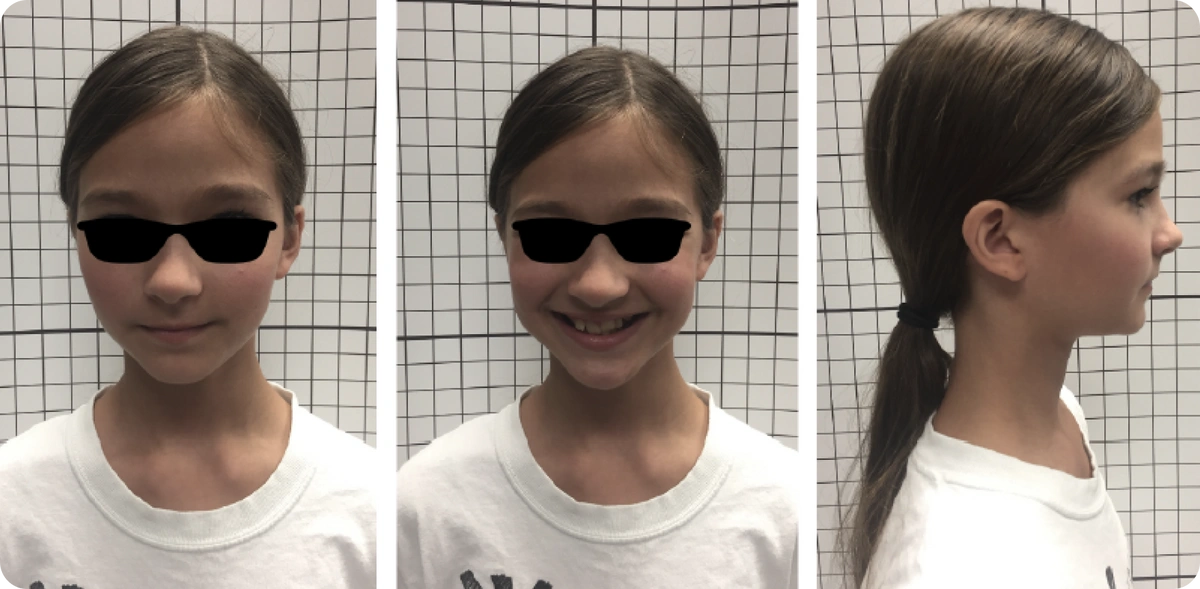
Toothpillow offers a free virtual pediatric airway assessment for children ages 3 to 12 in the United States. Parents upload six guided photos of the child's face, bite, upper jaw, lower jaw, and tongue position, then complete a clinical intake about habits, breathing, sleep, and development.
An airway-focused Toothpillow dentist reviews how the bite is developing, the width of the upper jaw, tongue and lip posture, and how a child breathes. For children who are candidates, the Toothpillow program guides natural jaw growth with oral appliances, myofunctional exercises, and habit support, so the jaw develops with room for the teeth and tongue. The goal is to give families the full growth and breathing picture in one place, along with a clear next step.
See how your child's bite and jaw are developing
The free Toothpillow assessment looks at the bite, upper jaw, tongue and lip function, breathing, and the habits you see at home, and every child gets a clear recommendation and a next step.
Get your child's free assessmentWhen should you worry about your child's thumb sucking?
Every child benefits from having their bite and jaw growth checked while they are young, and it is worth acting sooner when a sucking habit is frequent and has continued past around age three.3 Signs that make an evaluation more useful include front teeth that no longer meet, upper teeth that protrude, a back-tooth crossbite, a narrow or high palate, crowding as the permanent teeth come in, or a habit that continues as those permanent teeth erupt. Catching these while a child is still growing is far easier than correcting them later.
The best time to guide a child's bite is while they are growing
A prolonged thumb or pacifier habit can change how a child's front teeth meet and how wide their upper jaw grows. The clearest effect is an open bite, and the risk depends most on how long the habit lasts.
The encouraging part is that a child's growth is not fixed. When the habit stops and the child's development is guided while they are still young, much of the bite can recover, and the jaw can be helped to grow with enough room. The younger you start, the more room there is to make a difference.
If your child still sucks their thumb or a pacifier and you are seeing changes in their teeth, the simplest next step is a look at the whole picture: their bite, their upper jaw, how they rest their tongue, and how they breathe. That is exactly what Toothpillow's free assessment is built for.
Find out what your child's bite is telling you
Toothpillow's free virtual assessment gives parents of children ages 3 to 12 an airway-focused dentist's review of the bite, upper jaw, tongue and lip posture, breathing, and sleep. Upload six guided photos and get a clear picture and a next step.
Start your child's free assessmentDoes thumb sucking really change a child's teeth?
Yes, when it continues long enough. A prolonged thumb-sucking habit can push the upper front teeth forward, hold the front teeth apart so they do not meet, and narrow the upper jaw and palate. The clearest and best-documented change is an open bite, where the top and bottom front teeth do not touch when the back teeth are closed.
Can a pacifier cause a crossbite?
Longer pacifier use is linked with a higher chance of a posterior crossbite, where the upper back teeth bite inside the lower teeth, and with a narrower upper jaw. A crossbite is tied more strongly to prolonged pacifier use than to thumb sucking.
Does thumb sucking cause a high palate?
It can contribute. Prolonged sucking is linked with a narrower, higher palate in some children. How the palate grows is shaped largely by how the mouth is used every day, especially how a child breathes and where the tongue rests, so a sucking habit is one of several functional influences, and one that can be changed while a child is still growing.
Is thumb sucking connected to mouth breathing or sleep problems?
They affect some of the same things: where the tongue rests, how the lips sit, and how wide the palate grows. Thumb sucking has not been shown to directly cause mouth breathing or sleep apnea, but by narrowing the palate and lowering the tongue it can contribute to the crowded-airway pattern linked with sleep-disordered breathing. If a child snores, sleeps with their mouth open, or has pauses in breathing, that breathing deserves its own evaluation.
References
- Faryad A, Muwaquet Rodriguez S, Hijazi Alsadi T. The role of digit- and pacifier-sucking habits on malocclusion development in children: anterior open bite and posterior crossbite, a systematic review and meta-analysis. Dentistry Journal (Basel). 2026;14(1):55. doi:10.3390/dj14010055.
- Warren JJ, Bishara SE. Duration of nutritive and nonnutritive sucking behaviors and their effects on the dental arches in the primary dentition. American Journal of Orthodontics and Dentofacial Orthopedics. 2002;121(4):347-356. doi:10.1067/mod.2002.121445.
- American Academy of Pediatric Dentistry. Policy on Pacifiers. The Reference Manual of Pediatric Dentistry. Chicago, Ill.: American Academy of Pediatric Dentistry; revised 2024.
- American Academy of Pediatric Dentistry. Management of the Developing Dentition and Occlusion in Pediatric Dentistry. The Reference Manual of Pediatric Dentistry. Chicago, Ill.: American Academy of Pediatric Dentistry; revised 2024.
- American Dental Association. Thumbsucking. MouthHealthy. Accessed August 5, 2026.
- Arpalahti I, Hänninen K, Tolvanen M, Varrela J, Rice DP. The effect of early childhood non-nutritive sucking behavior including pacifiers on malocclusion: a randomized controlled trial. European Journal of Orthodontics. 2024;46(5):cjae024. doi:10.1093/ejo/cjae024.
- Cenci Nihi VS, Maciel SM, Jarrus ME, et al. Pacifier-sucking habit duration and frequency on occlusal and myofunctional alterations in preschool children. Brazilian Oral Research. 2015;29:1-7. doi:10.1590/1807-3107bor-2015.vol29.0013.
- Herrera S, Pierrat V, Kaminski M, et al. Risk factors for high-arched palate and posterior crossbite at the age of 5 in children born very preterm: EPIPAGE-2 cohort study. Frontiers in Pediatrics. 2022;10:784911. doi:10.3389/fped.2022.784911.
- Proffit WR. Equilibrium theory revisited: factors influencing position of the teeth. Angle Orthodontist. 1978;48(3):175-186.
- Paolantonio EG, Ludovici N, Saccomanno S, La Torre G, Grippaudo C. Association between oral habits, mouth breathing and malocclusion in Italian preschoolers. European Journal of Paediatric Dentistry. 2019;20(3):204-208. doi:10.23804/ejpd.2019.20.03.07.
- Hansen C, Markström A, Sonnesen L. Sleep-disordered breathing and malocclusion in children and adolescents: a systematic review. Journal of Oral Rehabilitation. 2022;49(3):353-361. doi:10.1111/joor.13282.
- Adriano LZ, Derech CD, Massignan C, et al. Anterior open bite self-correction after cessation of non-nutritive sucking habits: a systematic review. European Journal of Orthodontics. 2023;45(3):235-243. doi:10.1093/ejo/cjac054.
- Sadoun C, Templier L, Alloul L, et al. Effects of non-nutritive sucking habits on malocclusions: a systematic review. Journal of Clinical Pediatric Dentistry. 2024;48(2):4-18. doi:10.22514/jocpd.2024.029.
- Keyser MMB, Lathrop H, Jhingree S, et al. Impacts of skeletal anterior open bite malocclusion on speech. FACE. 2022;3(2):339-349. doi:10.1177/27325016221082229.
- Assaf DDC, Knorst JK, Busanello-Stella AR, et al. Association between malocclusion, tongue position and speech distortion in mixed-dentition schoolchildren. Journal of Applied Oral Science. 2021;29:e20201005. doi:10.1590/1678-7757-2020-1005.
- Zheng W, Zhang X, Dong J, He J. Facial morphological characteristics of mouth breathers versus nasal breathers: a systematic review and meta-analysis of lateral cephalometric data. Experimental and Therapeutic Medicine. 2020;19(6):3738-3750. doi:10.3892/etm.2020.8611.